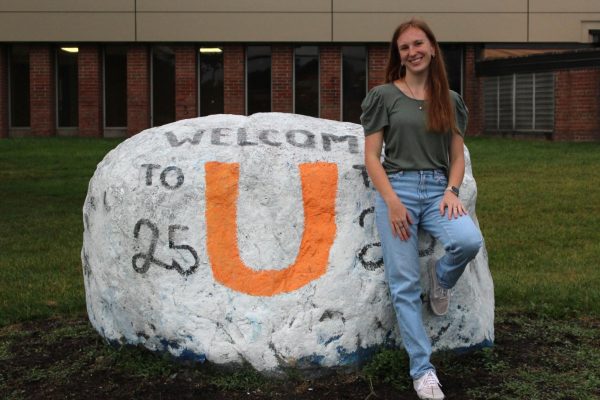


Utica High School science teacher Karyn McConachie is what one would call a lifelong learner. From earning two master degrees, a certification in International Society for Technology in Education (IST), completing the Macomb Area of Digital Educator (MADE) program, participating in the 21 things 4 project, and is an original member of the Utica Community Schools Geek Cohort; it seems like she had accomplished it all, until January came along.
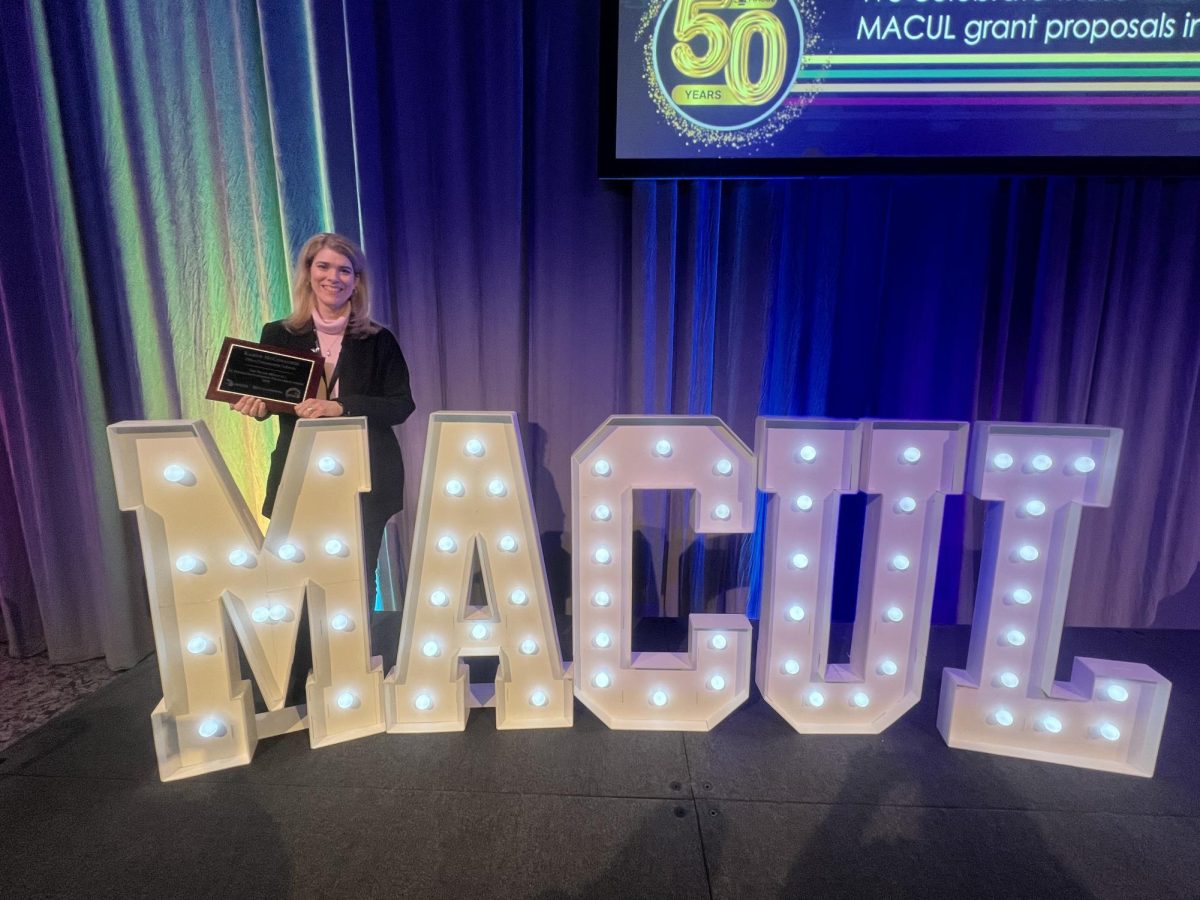
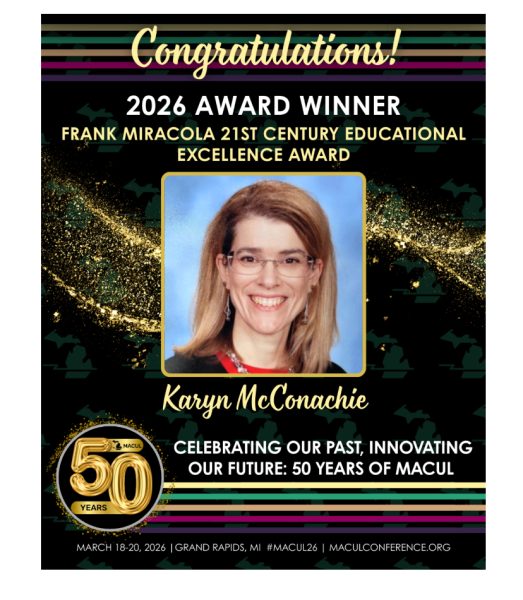 After learning about the Frank Miracola 21st Century Education Excellence award through a previous winner and friend, the long process of putting together a portfolio of accomplishments began, forming her application and submitting it soon after. One day, McConachie opened her email to “Congratulations! 2026 Award Winner Frank Miracola 21st Century Education Excellence Award, Karyn McConachie.”
“As anticlimactic as it sounds, I was sitting here at my desk when I found out and texted my husband right away; he was super excited, and we celebrated later as a family with a fun treat,” McConachie said. “Winning was kind of humbling and a little bit of a surprise I won, but it’s definitely a nice validation of the love, the work, and the things I’ve done to give my students some of those opportunities to learn new technology.”
McConachie not only carries the title as winner but also continues to carry on the legacy left behind by one of the original creators of the 21things4teachers, Frank Miracola. Miracola was a deeply loved educator who passed away to his battle with cancer in 2010. His passing caused the partnering of the 21things4team, along with the Regional Educational Media Center Association of Michigan (REMC), the Michigan Association for Computer Users in Learning (MACUL) organization, and the Michigan Virtual University (MVU) to continue to honor his legacy through the award. When selecting an annual winner of the Frank Miracola 21st Century Educational Excellence Award, they highlight educators that find a variety of resources to reach all learning styles in a challenging educational environment.
“Students sometimes get a bad rap when it comes to technology; like, ‘students are only on their phones and they only care about their phones.’ Well, in our world, technology is not going anywhere, and I think my students just need to know how to use technology productively,” McConachie said. “In order to do that, I need to understand what the technology has to offer. I can’t support them in learning how to graph in Excel or manage their OneNote notebooks if I don’t know how to use it myself, so I did all of that and it pushed me to apply for the award.”
In a challenging educational environment with many students; each one being different, it alone can be hard for a teacher to teach everyone the same curriculum for all of them to understand, and even more daunting to do it on different platforms, but McConachie has found the balance between the curriculum and the students.
“Having the confidence to say, ‘I’m going to try this, it might not work, but I’m going to try it,’ and then figuring out where mistakes happened and then go, ‘next time I’m going to do it this way’ is the best way to find the right places to put the technology within the content” McConachie said. “It depends on what I’m teaching, but I usually try to stick with what the kids have access to, but in the end, it depends on the student and what they’re comfortable in using. My goal is not to bury them in technology but to get them to be able to use it, too hopefully produce something that’s a really cool example of their learning.”
The time for McConachie’s public recognition at the MACUL Conference in Grand Rapids, Michigan on Mar. 18th through the 20th came swiftly with excitement and nervousness. Although she had attended the conference containing hundreds of breakout rooms and speakers for the past two years in Detroit, going to the Grand Rapids area, as well as receiving the award, opened up a whole new feeling of anticipation.
“Walking into a very large ballroom set up for probably 400 people and have your face show up on all three giant screens was like, ‘whoa.’ It was a little weird at first, but surreal,” McConachie said. “So many people that teach using educational technology are doing really awesome things, so it’s special, it’s such an honor.”
When one of her AP Biology students, senior Helio Perdodaj, was asked questions about the class and how it differentiates to an ordinary classroom, he reflected on his class experience that has only helped him become the student he is today.
“Something she does differently is she asks for the class’s input and actually responds to the constructive criticism. She’s a hard worker and is always trying to find a way to make something better,” Perdodaj said. “All of that has helped me study better and actually be able to apply what I learned in the future, and because of that she is a good teacher that helped us realize what we need to work on, and what we are strong in.”
This appreciation and recognition is not only noticed in her students, but also in Utica’s Principal, Timothy Youngblood, as he recognizes her infield experience provided by her first degree as an environmental geologist before earning her teaching degree gives her students an upper hand.
“She worked in the professional scientific field prior to becoming a teacher, so her perspective is from a real-life experience. Most teachers do not have that ability to draw directly from a professional life to the classroom, so she can always answer the question ‘how would we use this in the real world?’ Those differences give our students a true experience of learning and working as a scientist. This is not just book work; this is hands on learning and application,” Youngblood said. “She is a true teaching professional in every sense of the word. She takes her craft very seriously and is always looking for ways to improve. We are extremely lucky to have her at Utica High School.”
McConachie not only credits this accomplishment to her hard work and dedication, but to the loved ones around her; her mom Nancy Dodson, her husband Robert, and her daughter’s alumni Cameryn and junior Lauryn McConachie.
“To my mom, my husband, my daughters, and my students. Thank you for just constantly pushing me to be better. They make me a better teacher,” McConachie said. “They make me want to continue to learn and to make me become better as I keep moving through this career.”